Browser GTO solver for postflop study
Study a heads-up postflop spot on your own device. Explore ranges, strategy frequencies, EV and nodelocking. Features and allowances vary by plan.
Start free ↗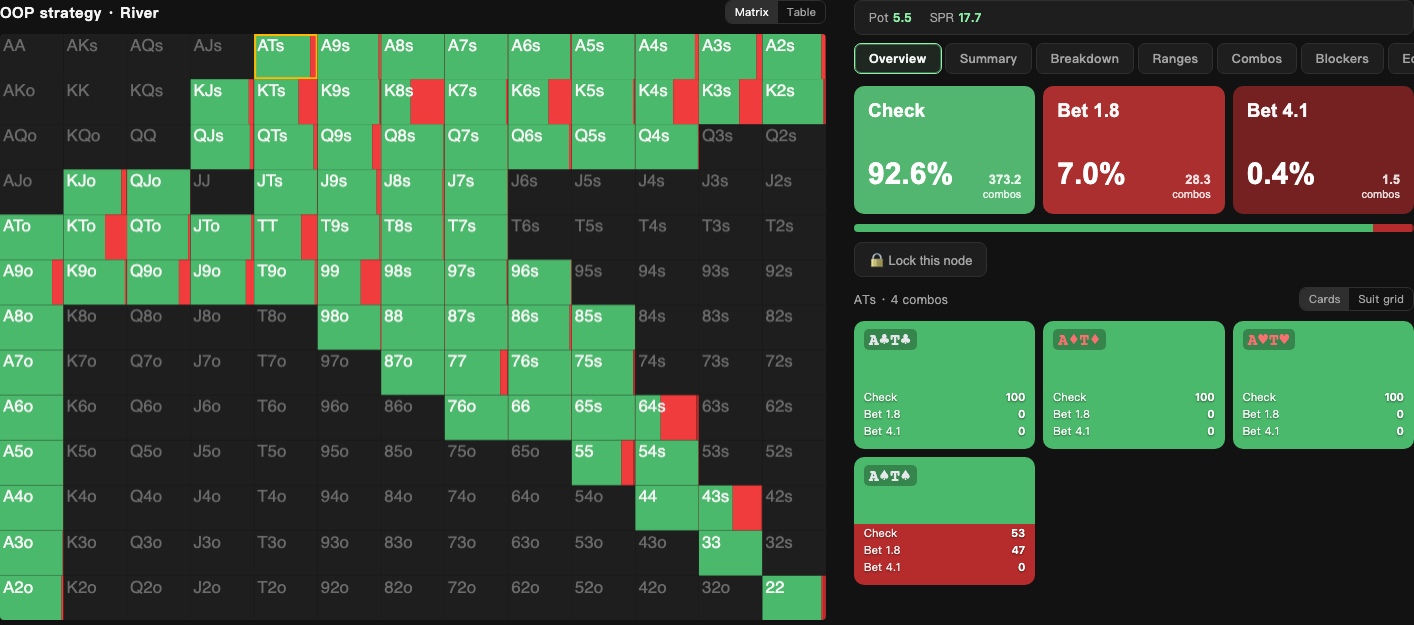
Poker study guides
Start with one question. Follow a real workflow, check its assumptions and choose your next exercise.
Build the game you want to study
Enter the board, pot, effective stack and both player ranges. Select the bet sizes and accuracy before solving. The result describes this configured game, not every possible poker situation.
Start with a river board such as Ks7h2d5c9s, a pot of 100 and effective stacks of 400. Use explicit ranges rather than assuming the opponent’s exact cards. A larger tree or earlier street generally takes more time and memory.
Read frequencies alongside EV
Inspect the range matrix, choose a hand combination and follow actions through the tree. A mixed strategy may use several actions; a low-frequency action is not automatically an error.
Compare the displayed accuracy and EVs before drawing conclusions. Changing ranges, rake or bet sizes changes the game and can change the answer.
Test an assumption with nodelock
Fix a strategy at a node and solve again to study a response to that assumption. Keep the rest of the configuration identical so the comparison is meaningful.
A locked strategy is a hypothesis about an opponent. The solver does not observe a live table or establish that a real opponent follows it.
Device and library limits
Solve time depends on your device, the tree and the target accuracy. The browser uses multithreading when cross-origin isolation is available. There is no promise that every flop solves in seconds.
The pre-solved library is a separate feature with its own available scenarios and training allowance. Check your account for feature access and allowances. Sign-in and online services require a connection.