How to set up a poker solver spot: ranges, pot and bet sizes
The inputs define the game the solver studies. Start with a small river situation you can reproduce, then change one assumption at a time. A more detailed tree is not automatically a more realistic model.
1. Use consistent units
Enter the board Ks7s2d5c9s, pot 5.5 and effective stack 20. These numbers can be treated as big blinds as long as every input uses the same unit. Stack means chips still available at this starting point, not the amount a player sat down with.
The downloadable worksheet records a small synthetic exercise with OOP range AA,QQ and IP range KK,JJ. These narrow ranges are for learning the controls, not a claim about realistic preflop play.
2. Set ranges for both players
Enter the complete range you intend each player to hold at the chosen street. Board cards remove impossible combinations. Check that the ranges still contain valid hands and that you did not accidentally put the opponent on one known showdown hand.
When studying an actual hand, document where the ranges came from: a library line, your hypothesis or a manually constructed range. A precise calculation cannot remove uncertainty in that assumption.
3. Keep the first betting tree small
Begin with a single bet size, 50% of the pot, and a limited raise setting. Check the interface’s size convention: a fraction such as 0.5 represents half-pot where the field uses pot fractions. It does not mean 0.5 chips.
The worksheet also records a 1.0 raise-size input and a one-raise cap for the engine smoke-test configuration. UI controls and defaults can differ across versions: record the values your actual interface permits rather than claiming an exact reproduction when you cannot match them.
4. Inspect output before comparing
After solving, inspect the board, ranges and available actions again. Record the reported accuracy or exploitability along with frequencies and EV. This worksheet supplies inputs, not a guaranteed output frequency or solve time.
For a controlled comparison, change just one range or bet size and keep everything else fixed. Earlier streets, wider ranges and additional actions can increase resource use. If the device struggles, return to the small river exercise rather than treating a stalled computation as an answer.
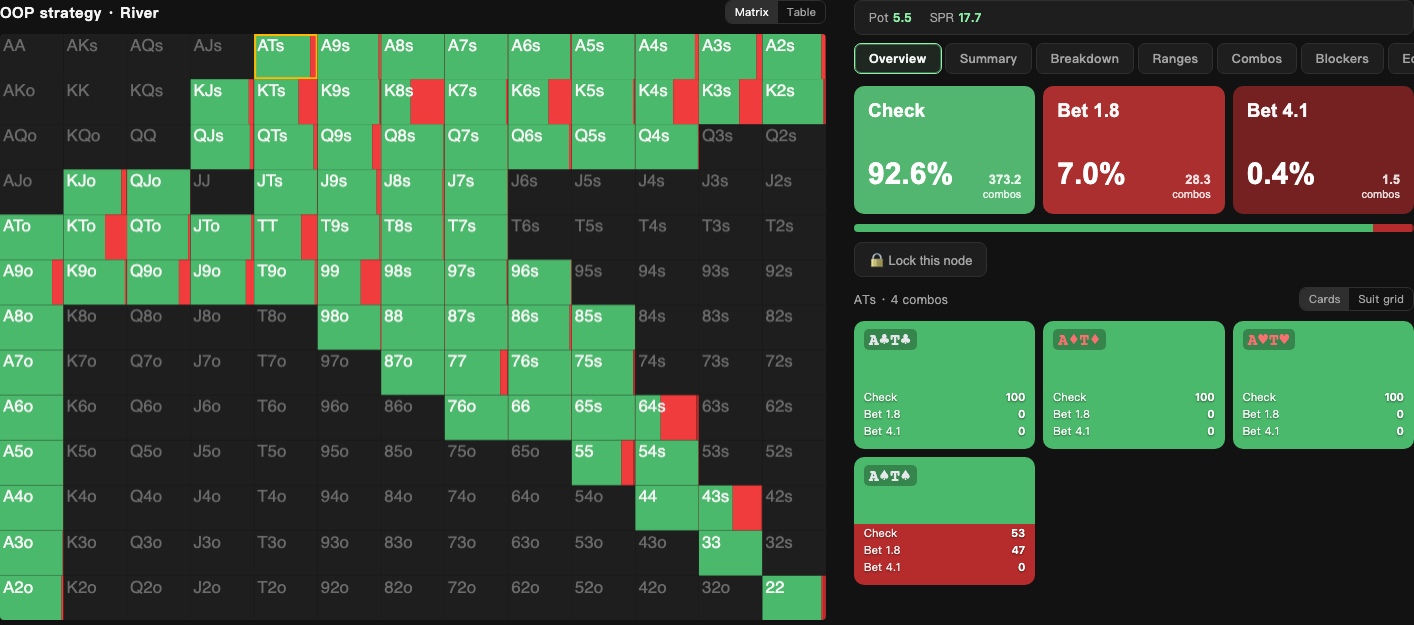
Recorded web interface example. Layouts and available controls can vary by version.